
Where Burke Crime News Appears
Sheriff Robert “Banks” Hinceman’s office speaks first on local crime. So does Morganton Public Safety. Both push out their own material directly. Newsrooms then add context and reach, but the agencies remain the actual record sources.
Burke’s media scene has several layers. The Paper runs a dedicated Courts and Crime section focused on the county. WHKY posts a Crime Report plus regional crime stories by category. WBTV keeps a Burke County page and has covered large multi-agency operations. The Morganton News Herald serves as the local daily. Each outlet plays a distinct role. None of them should be read as a complete list of everyone arrested in Burke County.
One trap deserves a warning. The city in a headline may just be a mailing address, not the arresting jurisdiction. Check the agency and facility fields whenever a story mentions Morganton, Valdese, Drexel, or another Burke community.
Burke News Outlets and Sources
The table below separates each source’s role from the question of whether a photo shows up. Photos depend on the story. An agency may supply one. A news photographer may take one. Or none may appear at all.
| Outlet | Coverage | Photos? | Where to look |
|---|---|---|---|
| The Paper | Burke courts, crime, arrests, warrants, and jail appearances. | Sometimes, including agency-supplied images. | Courts and Crime section. |
| WHKY | Frequent regional crime stories, wanted-person arrests, and court charges. | Story-dependent. | Crime Report and Crime category. |
| WBTV | Regional public-safety and county crime reporting. | Sometimes, with agency courtesy noted. | Burke County page and individual stories. |
| Morganton News Herald | Local daily coverage for Morganton and Burke communities. | Varies by story and access level. | Local news entry point. |
| Burke Sheriff | Official Sheriff news and public-safety releases. | Selective attachments or images. | Sheriff News and linked county pages. |
| Morganton Public Safety | Official city crime and incident releases. | May include case details or an image. | Crime and Incident Releases. |
| County-local aggregators | Unofficial county indexes and archives. | Often, but accuracy and dates vary. | Busted Newspaper, RecentlyBooked, Mugshots.com, Arrests.org, or Mugshots.zone by name only. |
Those aggregator sites in the last row are not official Burke sources. Their pages can sit stale for months, list the same person twice, or mislabel where an image came from. Treat them, at most, as a lead. Verify against the county roster, the records unit, and the court before relying on anything they show. No aggregator image appears on this site.
How Photos Reach Burke News
How does a booking photo end up in a story? Several paths exist. An agency might attach one to a press release. A reporter can request public material from the custodian who holds it. A news desk might run an image supplied with a law-enforcement or court account. None of this means the agency runs a standing public gallery of every booking.
North Carolina law shapes what is available. G.S. 15A-502 allows photographs and fingerprints for law-enforcement records in certain circumstances, within limits, and it does not force agencies to post every mugshot online. Public-record access under G.S. 132-1 and the criminal-investigation rules in G.S. 132-1.4 still leave room for confidential or redacted material.
For a concrete case, look at WBTV’s Operation RED report, which covered a multi-agency operation using images credited as BCSO courtesy photos. Useful context, yes. But a story is not a live roster, so turn to the official county catalog for anyone’s current custody status.
The regional report shows how an agency-supplied image can accompany a Burke enforcement story.
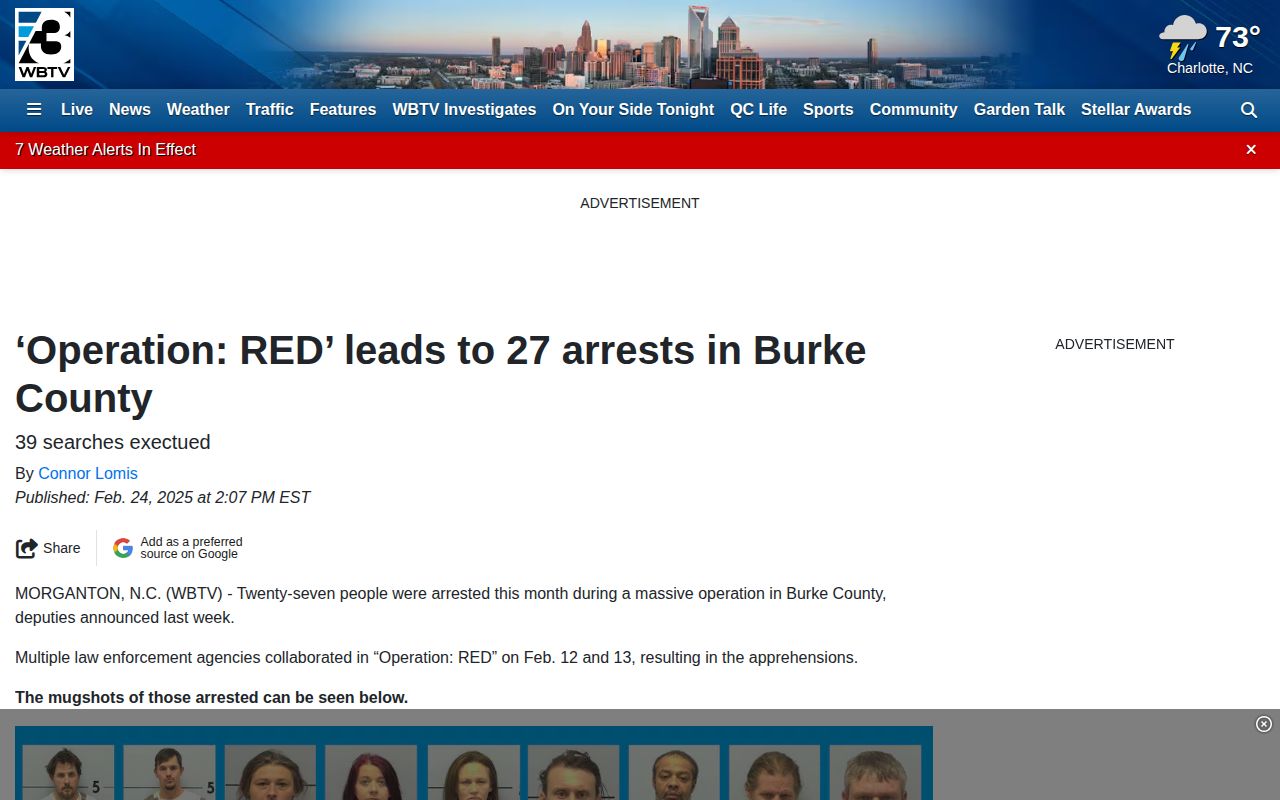
Use a linked story for its own date and its own source language, then confirm custody and court status through official channels.
From a Story to the Record
A news story earns its keep when it gives you a full name, an agency, a date, and a charge. From there, match the record to its custody state. Timing matters. Someone named in a story may already be out by the time you read it. The live roster may not return the same person.
- Copy the person’s name, the story date, the named agency, and any booking or case number. Keep the story URL for context.
- Check the Burke Police to Citizen inmate catalog for current county detention data. Compare the result’s agency, charge, facility, bond, and dates.
- Check the Daily Bulletin for the date and event type, then check the separate Recent Arrests catalog. Each is a different official view.
- If the booking is no longer online, ask the Sheriff Records unit or the arresting city department for the existing record and any releasable photo.
- Search the North Carolina Judicial Branch Burke County route and eCourts for the case and later disposition. Match identity details carefully.
Headlines fade; court files remain. An arrest makes news, but the paperwork that follows tells the fuller tale. Charges get reduced. Some are dropped. Others stick after a judge weighs the facts. Only the official record shows what a case in Burke County finally became.
The county-wide roster, the booking-record request process, and the court path are all laid out together on the Burke County records and arrest search page. That route also helps when a city story names Morganton, Valdese, Drexel, or a nearby community without saying where the person was actually booked.
News Patterns in Burke County
NCDAC, the state corrections department, comes into play later in a custody timeline, not in the county news cycle. A state profile is a follow-up step. It cannot stand in for the original Burke County booking record.
Notice which agency a story credits. Was it the Sheriff, Morganton Public Safety, Valdese Police, or Drexel Police? That one detail points toward the right record custodian and tells a county booking apart from a city incident.
Local outlets shape the picture. The Paper and WHKY report court and arrest stories out of Morganton and the rest of the county, while WBTV brings regional reach to larger efforts like Operation RED. Morganton's own releases can add bond amounts, first appearances, and court dates. A checking-station arrest release shows how a city publication bridges an arrest story to a court event, though it stops short of a full arrest log.
News volume tracks events, nothing more. A slow news day proves nobody was booked? No. A busy one proves everyone named is still locked up? Also no. Weekend activity, delayed posting, releases, and shifting court dates mean the story, the feed, the roster, and the docket can carry different dates for the same case.
City coverage runs unevenly, too. Morganton publishes official crime releases through its combined Public Safety department. Valdese and Drexel turn up in county stories, but neither offers a daily photo feed of its own. The agency and facility named in a record matter far more than a broad location label.